Every robot still needs a human.
We run the network.
SIM XR operates a network of vetted VR teleoperators — and the full chain around them: recruiting, certification, teleop infrastructure, quality control, and dataset delivery. Hire operators in-house, embed them on contract, or hand us the whole program. If your task involves a human driving a robot, it starts here.


Teleoperation became the most important job in robotics.
Teleoperated demonstrations are now the primary training input for vision-language-action models — and the fastest-growing job category in physical AI. Robot companies are hiring operators for data collection, pilot deployments, and human-in-the-loop recovery. The vacancy is easy to post. Everything after that is the hard part.
Pain 01
An untrained operator produces interface-adaptation noise, not task demonstrations. Sourcing, testing, certifying, and coaching operators is a discipline of its own — and it's where most collection programs quietly fail.
Pain 02
Low-latency VR streaming, headset fleets, episode recording, sensor sync, format conversion — months of engineering before the first useful demonstration, none of it your core roadmap.
Pain 03
Scenario diversity, in-session QA, and re-collection policy decide whether ten thousand episodes make your model better — or teach it the same easy case ten thousand times.
Recruit them. Embed them. Or hand us the keys.
Work with the network the way you'd work with any specialist talent partner — except we also built the stack your operators will run on. Three models, freely mixed:
We source, test, and certify operators against your actual task — you interview the shortlist and hire them as your own employees. You get people who passed a real teleop trial, not a resume screen.
Certified operators from the network work inside your team — your stack, your schedule, your tasks — while we handle sourcing, certification, coaching, and backfill. Scale hours up and down with your training runs.
Hand us the task. We run the whole chain — operators, infrastructure, scenario scripting, QA — and deliver training-ready demonstration data shaped to your pipeline.
Not sure which fits? Every engagement starts with the same scoped trial batch — decide after you've seen the data.
One entry point. The whole chain.
Whichever model you pick, the same capabilities sit underneath. Take the whole chain or the one piece you're missing — bring us a task where you need a human in the loop, ideally your scene and your assets, and we'll scope it.
Vetted VR teleoperators from our network, on your stack or ours. Remote-first, trialed on your task before they touch production collection.
- Platform-specific certification before first session
- Trial batch on your task, then scale
- Recruit-to-hire, embedded, or managed
The full program: scenario scripting, collection, in-session QA, and delivery shaped to your training pipeline — not a folder of raw recordings.
- Scenario & diversity engineering up front
- Episode-level QA with defined pass/fail criteria
- HDF5 / LeRobot-ready delivery formats
We design qualification tests and train operators — ours or your in-house hires — on your hardware, your interface, your task list.
- Task-specific qualification criteria
- Structured ramp: sim reps before real hardware
- Ongoing quality review, not one-time onboarding
Our own stack, built and operated in-house: consumer VR headsets streaming into GPU-cloud simulation, with photoreal scene reconstruction when the task needs your environment.
- Low-latency VR streaming to Quest-class headsets
- Simulated environments in NVIDIA Isaac Sim / Isaac Lab
- 3D Gaussian Splatting reconstruction of real scenes
Task to trial in three steps.
Tell us what the human needs to do — robot, task, environment, target volume. We come back with a concrete plan: operator profile, setup, timeline, and price for a trial batch.
Operators certified on your task run a small paid pilot. You review the episodes against agreed pass/fail criteria — quality is proven on your data, not promised on a call.
Keep the operators embedded on contract, hire them in-house, or hand us the full program. The trial tells both sides exactly what scaling will look like.
We've done every job we staff.
We don't resell hours. We built the loop ourselves and run it in-house — from a consumer headset on an operator's desk to an evaluated robot policy — so when we place an operator or scope a program, the judgment comes from running the chain, not from a staffing playbook.
Consumer Quest headsets stream into our GPU-cloud simulation over our own low-latency VR stack. We reconstruct real environments as 3D Gaussian Splatting scenes, capture demonstrations, prepare datasets, fine-tune vision-language-action policies, and evaluate them against task success — the same loop your program needs, already running.

Case 00: we were our own first customer.
Before offering the chain to anyone else, we ran it end to end ourselves. We built a browser-to-headset teleop stack — consumer Quest headsets connecting in one click to live GPU-cloud simulation scenes — and reconstructed real environments as photoreal 3D Gaussian Splatting scenes inside NVIDIA Isaac Sim.
Then we proved the training side of the loop: fine-tuned a vision-language-action policy for a pick-and-place task on a humanoid robot and evaluated it against strict task-success criteria — using the same pipeline, QA gates, and data formats we run for customer programs.
Anyone putting a human in the robot loop.
Data collection programs and certified operators without building an ops team — scale operator hours up and down with your training runs.
Demonstration data shaped to your training pipeline: scenario diversity engineered up front, QA'd per episode, delivered in your format.
Small, scoped collection batches with fast turnaround — enough episodes to test a hypothesis, without procurement overhead.
Trained remote operators for supervised autonomy, edge-case recovery, and pilot deployments where a human still closes the loop.
Join the operator network.
We onboard operators continuously and staff new projects from the network — early applicants get first sessions. All roles are remote and project-based: you work from your own VR headset, sessions are scheduled per program.
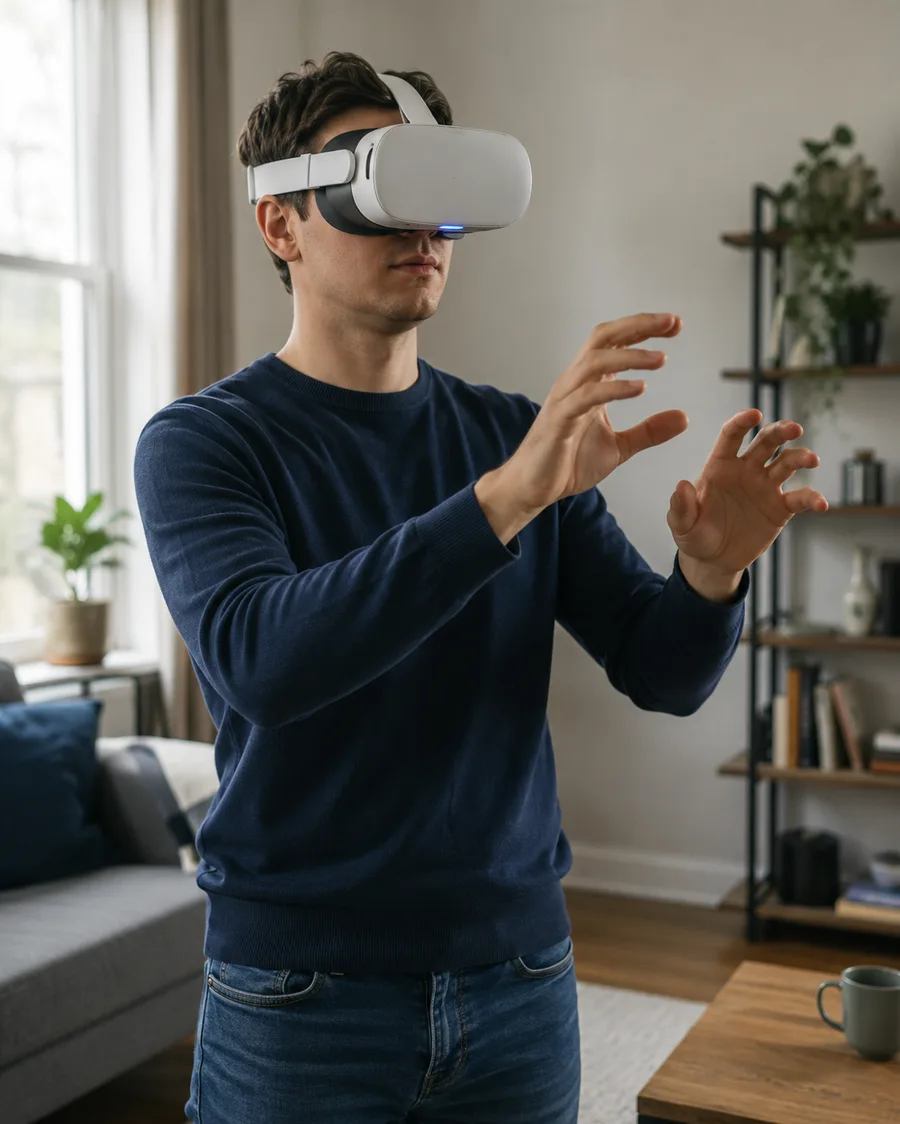
Drive simulated and real robots through manipulation tasks from your VR headset. Sessions are recorded as training demonstrations — your skill becomes the data that teaches robots. Quest 3 or similar required; no robotics background needed, coordination and consistency are what we test for.
Apply →Review collected episodes against pass/fail criteria, coach operators, and test-drive new task setups before they go to the network. Grows from within the network — strong teleoperators are promoted into this role.
Apply →More roles open as programs scale. One application covers the whole network — we match you to projects.
The questions every program asks first.
Do operators work remotely or on-site?
Remote-first. Operators connect from their own VR headsets through our low-latency streaming stack into your simulator or robot. For programs that require physical presence — hardware calibration, on-premises robots, secure facilities — we recruit and place operators on-site.
Can we hire your operators in-house?
Yes. Recruit-to-hire is one of our three engagement models: we source, vet, and certify operators against your task, you interview the shortlist and hire them as your employees. We charge a placement fee and stay available for training support.
Whose hardware and software stack do you use?
Either. Operators are certified per platform — we train them on your teleop interface and hardware if you have one, or run the whole program on our own stack: consumer VR headsets streaming into GPU-cloud simulation, with 3D Gaussian Splatting reconstruction of your environment when the task needs it.
What data formats do you deliver?
HDF5 and LeRobot-ready formats today, with delivery shaped to your training pipeline — episode structure, sensor sync, and pass/fail QA criteria are agreed before collection starts, not after.
How does pricing work?
Depends on the model: placement fee for recruit-to-hire, hourly or monthly rates for embedded contract operators, per-episode or per-program pricing for managed data collection. Every engagement starts with a scoped trial batch so both sides can verify quality before committing.
How fast can we start?
Scoping starts as soon as you describe the task. First trial sessions run once operators are certified on your specific setup — for tasks on our own stack that is typically days, not months.
Tell us the task.
Bring us a task where you need a human in the loop — data collection, pilot operations, operator hiring, or all of it. We'll come back with a scoped proposal: operators, setup, timeline, and a priced trial batch.
One reply from the team. No mailing list.